According to the ISO 513 standard, the M group of applications relates specifically to the machining of stainless steels (s.s.) with an austenitic structure, using hard cutting materials such as cemented carbides and ceramics. In the context of chip removal, why does this type of stainless-steel form a separate group, and what are the main challenges associated with machining ISO M materials?
Historically, the grouping of metal cutting applications was closely related to chip formation characteristics. Tools designed for machining materials within the same group typically feature similar cutting geometry. In the mid-20th century, this approach, originating in German technical terminology, was reflected in the identification letters of the different groups. Initially, there were only three groups: P, M, and K.
P (from the German word "Plastisch," meaning plastic or ductile) indicated materials that experienced plastic deformation during machining, producing long, flowing chips. This group primarily covers steels, including ferritic and martensitic stainless steels. In contrast, K (from "Kurz," meaning "short" in German) referred to abrasive materials, such as cast irons, which form short chips.
Falling between the P and K categories was one more group, denoted by the letter M (from "Mittel," the German word for “middle”). This group comprised materials exhibiting combined chip formation properties: sharing characteristics with both long-chipping steels and the short-chipping abrasive metals. Known also as the “mixed group” (“Mischgruppe”), it was indicated by the letter M.
Austenitic stainless steel ultimately became the primary material classified within this middle group M. Due to high corrosion resistance and good formability, austenitic stainless steel represents most of the stainless steel used worldwide. The estimated share of these steels is more than 70%. To be more specific, the austenitic stainless-steel grades like AISI 304 and 316 (DIN/EN W-Nr. 1.4301 and 1.4401 correspondingly) are the most popular. When selecting a cutting tool and finding cutting data when machining ISO M materials, one should focus explicitly on these grades. Probably, it was correct in the past, but today the situation looks different.
Evolving industry demands and advances in metallurgy have led to a broader use of other stainless steels with austenitic structures. Terms such as "super austenitic" and "duplex stainless steels" have become firmly established in the daily lexicon of manufacturers. Despite sharing features in tool geometry, these steels can differ significantly from traditional austenitic stainless grades in terms of machinability.
Super austenitic stainless steel is austenitic s.s. with high content of molybdenum and increased percentage of chromium and nickel. The combination of materials results in high resistance to pitting corrosion.
Duplex stainless-steel features a two-phase metallurgical structure: austenitic-ferritic, approximately in equal shares. Super duplex stainless steel is a type of duplex s.s. that contains an increased percentage of chromium and molybdenum for better corrosion resistance.
Heat-resistant austenitic stainless steel is austenitic s.s. specially designed to maintain mechanical properties and oxidation resistance at elevated temperatures, typically above 600 °C (1112 °C). These steels has high chromium and nickel content. Therefore, a significant part of heat-resistant s.s. falls into ISO S group of applications as high-temperature iron-based alloys.
The main difficulties in machining ISO M materials
The machinability of different austenitic steels varies over a noticeable range. For example, the machinability rating of super duplex stainless steel can be about half, or even less, compared to a typical austenitic steel such as AISI 304. So, what makes machining ISO M materials exceptionally challenging?
Austenitic stainless steels have a pronounced tendency to work hardening: they become increasingly hard as they deform during machining. Their high material strength leads to increased cutting forces. In addition, these steels exhibit poor thermal conductivity, causing a rise of temperature in the cutting zone. They are also prone to build-up edge (BUE) formation on the cutting tool. Moreover, their tendency to produce stubborn chips ("mixed" ISO M group!) complicates chip control. All these factors negatively impact cutting action, accelerate tool wear, and affect machining accuracy and surface finish.
Duplex and super duplex stainless steels, which are tougher and more abrasive than austenitic grades, present additional challenges by making tool wear even more problematic. Heat-resistant austenitic stainless steels, due to their strength at high temperatures, further emphasize issues such as work hardening and chip control. In fact, heat-resistant austenitic stainless steels belong to the most difficult-to-machine types of steel.
How can cutting tool producers address these challenges?
Cutting tool producers have a limited set of approaches to significantly improve performance in ISO M applications. These include developing advanced cutting materials and coatings, optimizing tool macro- and micro-geometries, providing efficient coolant delivery systems, and enhancing tool design to increase strength and rigidity. Additionally, offering customer support to help users select the most suitable tools and determine optimal machining parameters is important. Finally, ensuring the rational and cost-effective use of cutting materials remains a fundamental aspect of the producer’s arsenal.
The approaches mentioned above may seem quite general and, in principle, define strategies to improve cutting tool efficiency for any machining application, and not just for the ISO M group. This is true; however, systematically applying these common methods is a proven way to ensure continual advancement in tool solutions, leading from seemingly small upgrades to real breakthroughs in machining various engineering materials, including austenitic stainless steels.
ISCAR's latest development to tackle the issue
ISCAR, maintains a strong focus on high-performance solutions for machining austenitic stainless steels. The new products added to the company’s portfolio in recent years are aimed at enhancing effectiveness in ISO M applications.
In the drilling line, IC948, a new carbide grade with a submicron substrate, has been engineered to increase wear resistance when machining ISO P and ISO M materials. The special nanolayered PVD coating increases resistance to build-up edge (BUE) development.
The cost-effective hole-making tools with exchangeable carbide heads of the QUICK-3-CHAM family have been expanded to include three-flute counterboring heads
(Fig. 1). The three-flute design enables higher productivity, improved stability, greater hole accuracy, and more efficient use of cutting material. A key feature is the specially shaped deflector, which facilitates breaking chips into very small segments. This significantly boosts performance when machining difficult materials such as austenitic stainless steels and high-temperature superalloys (HTSA).
In the milling line, ISCAR has significantly expanded its range of indexable tools with the option of pinpointed high-pressure coolant (HPC) supply. The design of new tools, such as those in the HELI-3-MILL and HELIDO Trigon families
(Fig. 2), leverages additive manufacturing (AM) technology to maximize the benefits of computational fluid dynamics (CFD) in optimizing the shape of internal coolant channels. These tools are also suitable for milling with minimum quantity lubrication (MQL). Furthermore, they enhance cutting performance even with conventional pressure levels, for both wet and dry machining. Precisely directed coolant supply to the cutting zone greatly improves cooling and lubrication, resulting in superior machining performance and extended tool life, especially in ISO M applications. In the threading line, the HPC option has been successfully implemented in the design of new square-shank tools with internal coolant channels
(Fig. 3). High-pressure cooling ensures shorter chips that are easily managed and do not tangle around the workpiece or machine-tool parts.
Machining austenitic stainless steels presents demanding challenges, including intensive tool wear, complex chip control, and heat management. Through constant innovation in cutting materials, tool geometry, and cooling options, manufacturers like ISCAR enable higher productivity and improved machining results in ISO M applications. Ongoing development of innovative tooling strategies will remain essential for successfully navigating the complexities of modern austenitic stainless-steel machining.




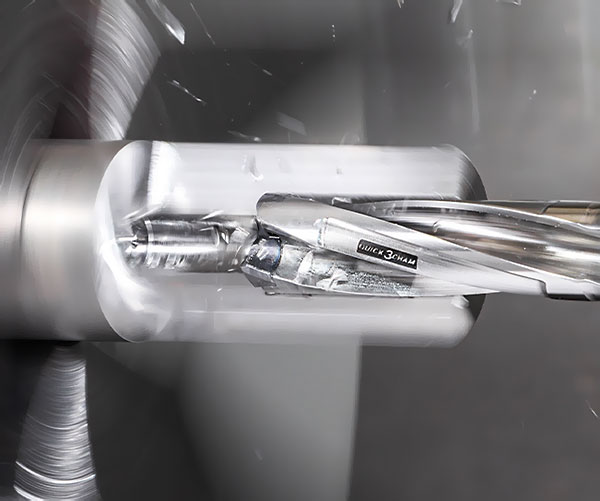 Fig.1
Fig.1
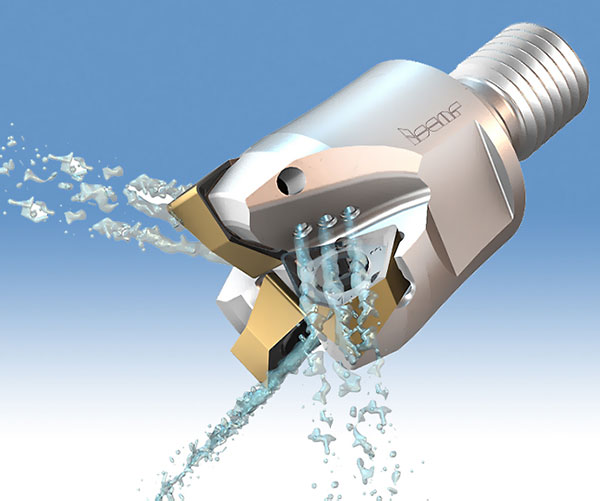 Fig.2
Fig.2
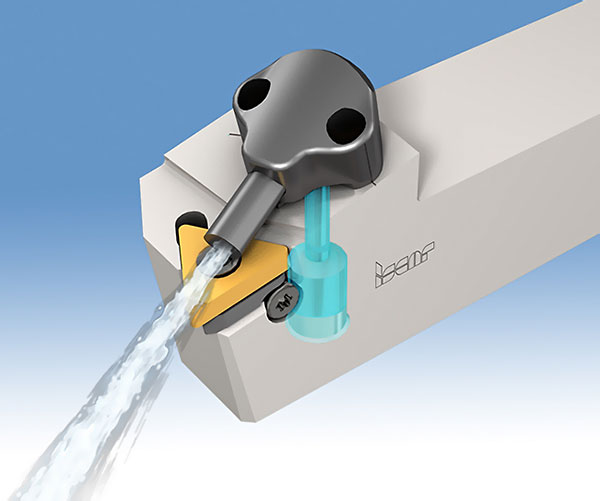 Fig.3
Fig.3